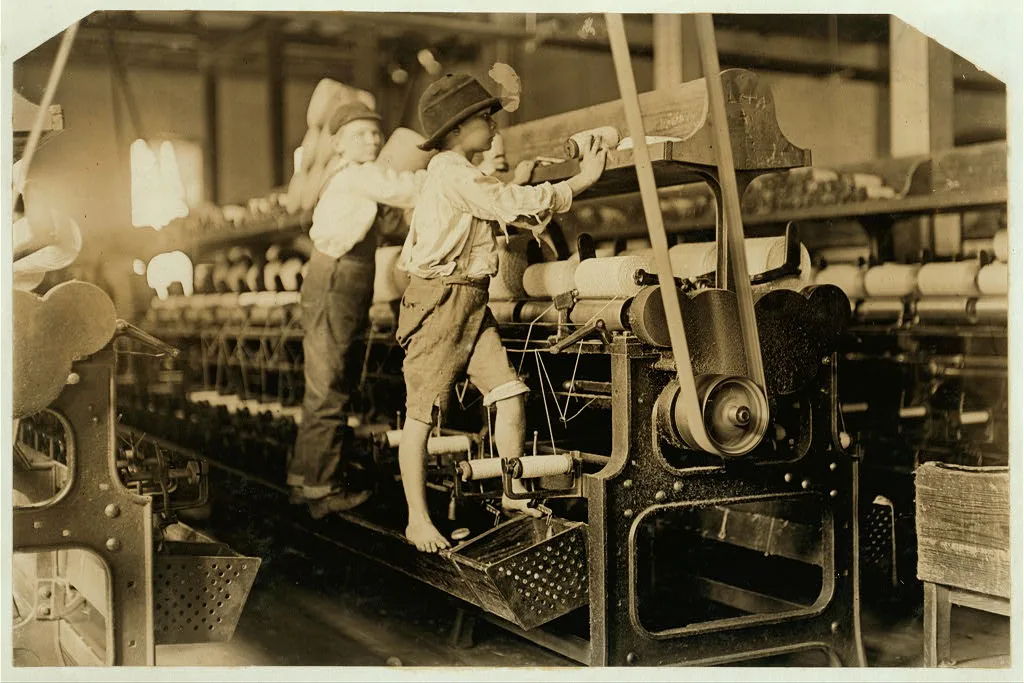
Boys on the Spinning Frame, Bibb Mill No. 1, Macon, Georgia (1909)
On January 19, 1909, Lewis Hine photographed two boys climbing onto a spinning frame in Bibb Mill No. 1 in Macon, Georgia. His caption explains that some boys were so small they had to climb up on the machine to mend broken threads and replace empty bobbins. The barefoot boy balanced on the frame became one of the most widely reproduced images of child labor in the American South.
- Date
- January 19, 1909
- Place
- Bibb Mill No. 1, Bibb Manufacturing Company, Macon, Georgia
- Photographer
- Lewis W. Hine for the National Child Labor Committee
- Medium
- Photographic print; glass negative, 5 x 7 in.
- Collection
- Library of Congress, National Child Labor Committee collection, LOT 7479, v. 1, no. 0488 (Hine no. 488); reproduction nos. LC-DIG-nclc-01581, LC-DIG-nclc-05394
- Also known as
- Bibb Mill No. 1, Macon, Ga.; Mill Children in Macon; Some boys were so small they had to climb up on the spinning frame; Children Working in a Textile Mill in Georgia
The mill and the visit
The Bibb Manufacturing Company was founded in Macon in 1876 by cotton merchants and grew into one of the largest textile firms in Georgia. In 1878 it bought a second Macon factory, and the two became Bibb Mill Number One and Bibb Mill Number Two. By 1911 the company ran nine Georgia mills, four of them in Macon.
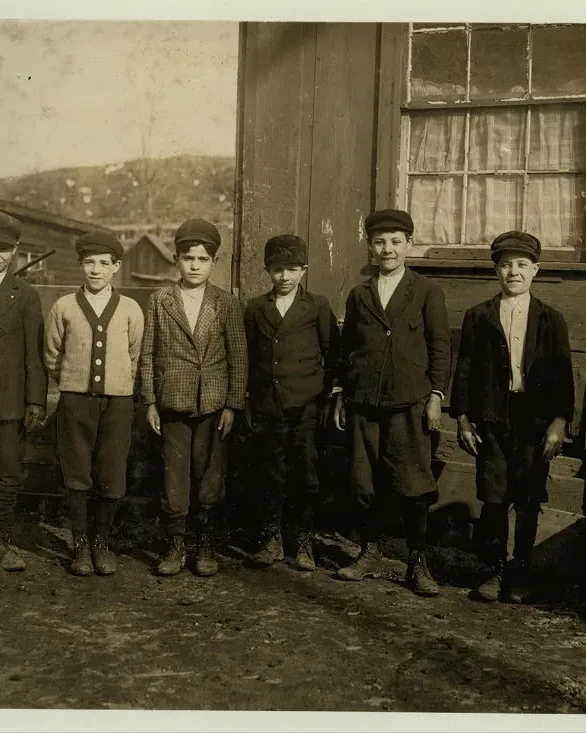
Hine came to Macon in January 1909 on a tour of Southern cotton mills for the National Child Labor Committee, which had hired him the year before. He made about thirty photographs in the town's mills that month. At Bibb Mill No. 1 he photographed groups of boys at the mill and noted their names, years of work and daily pay, and he photographed the spinning room, where this picture was made.
What the photograph shows
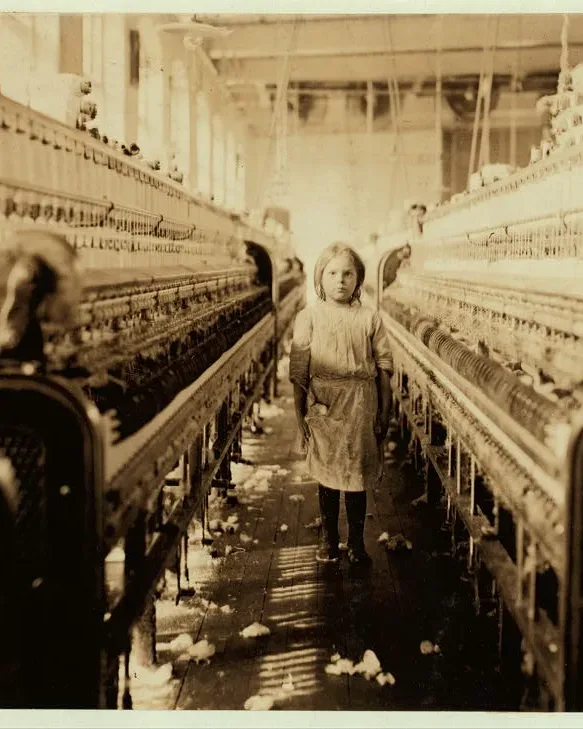
Two boys work at a spinning frame, a long machine carrying rows of spindles and bobbins. The nearer boy, in a cap, a loose shirt and short trousers, stands barefoot on the frame itself, one foot on a narrow rail, reaching up with both hands to the bobbins at the top. A second boy stands behind him on the same machine. The frame recedes in a long line toward the windows, and the floor and machinery are dusted with lint.
The caption, transcribed from Hine's card, gives his negative number, the date 1-19-1909 and the place, and then explains the scene: many youngsters were at work here, and some boys were so small they had to climb up on the spinning frame to mend the broken threads and put back the empty bobbins. Hine did not record the names of these two boys. The version of the caption kept with the National Archives print speaks of boys and girls rather than boys alone.
Why it became famous
The picture makes its argument without words. The machine is built for adults, and the boy has to climb it to reach the work. His bare feet on the iron rail suggest both poverty and danger, and the receding line of spindles shows how much of the room the children were responsible for.
The National Child Labor Committee used Hine's photographs in reports, publications, newspaper placements and traveling exhibits to build support for child labor laws. This image has remained in use ever since. Both the Library of Congress and the National Archives hold prints, the National Archives copy among the records of the federal Children's Bureau, and the National Archives uses it in its DocsTeach collection of documents for teaching history.
The other boys of Bibb Mill
Hine's group portraits from the same mill give names to some of the children around this scene. One caption names Otto Sheldo as the smallest boy, with two years in the mill. The researcher Joe Manning later identified him as Otto Harrison Shelton, born in Macon in 1898 and so about ten years old when Hine photographed him. Shelton's daughter recalled that he worked in the mill because his parents told him to and that he had to stand on a platform to change spindles. He later worked for the Central of Georgia Railroad and died in Macon in 1976. Manning notes that Shelton is not one of the two boys on the spinning frame, whose names remain unknown.
What to look for
Start with the boy's feet. One bare foot rests on a thin rail of the frame and the other on a lower bar, and his body leans in toward the bobbins as he works with both hands above his head. Then follow the frame back into the room: the repeated spindles, belts and pulleys run toward a bright window, and the second boy and the machines behind him soften in the haze of light and lint. In the foreground a metal basket and the heavy iron end of the frame, with its drive wheel, are much closer to the boys than any adult. Hine made the picture with a view camera on glass, and the detail in the negative is fine enough to show the threads running down from the bobbins.
The print in this archive
This archive holds the Library of Congress record for Hine number 488, from the album titled Mills. The Library has both a photographic print and Hine's original 5 x 7 inch glass negative, and both have been digitized: LC-DIG-nclc-01581 is the color scan of the print and LC-DIG-nclc-05394 the scan of the negative. Other photographs from Hine's January 1909 Macon visit in this archive include several group portraits of boys at Bibb Mill No. 1, including the one that names Otto Sheldo, and pictures of the Manchester, Payne and Willingham mills. When looking at the image, notice the scale: the top of the frame is above the boy's head even while he stands on the machine.
Frequently asked questions
Where was the Bibb Mill photo taken?
In Bibb Mill No. 1 of the Bibb Manufacturing Company in Macon, Georgia, on January 19, 1909.
Why are the boys climbing on the machine?
Hine's caption says some boys were so small they had to climb up on the spinning frame to mend broken threads and put back the empty bobbins.
Who are the boys in the Bibb Mill photograph?
Hine did not record their names. Other photographs from the same mill name boys such as Otto Sheldo, later identified as Otto Shelton, but he is not one of the two boys on the spinning frame.
Where can I see the original?
The Library of Congress holds a print and the original glass negative in its National Child Labor Committee collection (Hine no. 488). The National Archives holds a print in the records of the Children's Bureau.
Sources
- 488 Macon, Ga. ... Bibb Mill No. 1 (Library of Congress catalog record)
- Children Working in a Textile Mill in Georgia (National Archives, DocsTeach)
- Otto Shelton (Mornings on Maple Street, Joe Manning)
- Bibb Manufacturing Company (New Georgia Encyclopedia)
- National Child Labor Committee Collection: About this Collection (Library of Congress)