A Little Spinner in the Mollahan Mills, Newberry, South Carolina (1908)
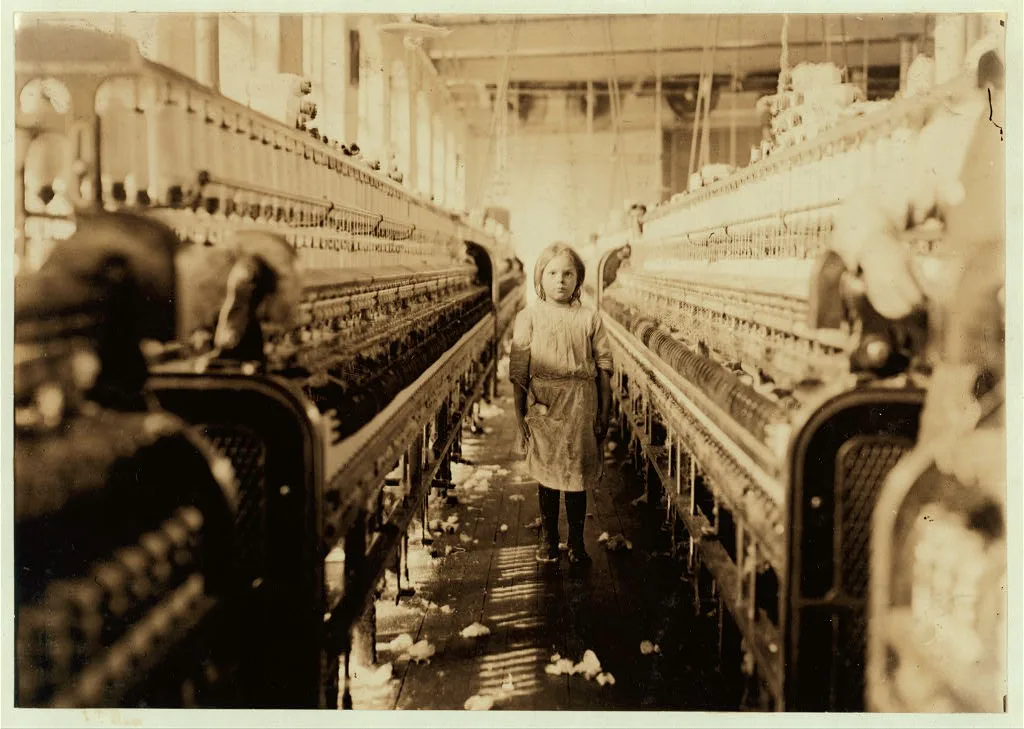
On December 3, 1908, Lewis Hine photographed a small girl standing in the aisle between two long spinning frames at the Mollahan Mills in Newberry, South Carolina. His caption records the overseer's excuse that she had just happened in. The picture, with its long perspective of machinery closing in on a single child, is among the best known of Hine's Southern mill photographs.
- Date
- December 3, 1908
- Place
- Mollahan (Mollohon) Mills, Newberry, South Carolina
- Photographer
- Lewis W. Hine for the National Child Labor Committee; witness Sara R. Hine
- Medium
- Photographic print; glass negative, 5 x 7 in.
- Collection
- Library of Congress, National Child Labor Committee collection, LOT 7479, v. 1, no. 0358 (Hine no. 358); reproduction nos. LC-DIG-nclc-01451, LC-DIG-nclc-05382
- Also known as
- A little spinner in the Mollahan Mills; She just happened in; Little spinner, Newberry, S.C., 1908
Hine in the Carolina mills
The National Child Labor Committee hired Lewis Hine in 1908, and the cotton mills of the Carolina Piedmont were among his first assignments. Owners and overseers were often suspicious of investigators, and Hine got inside by presenting himself in various roles, among them a Bible salesman, a postcard salesman and a photographer recording factory machinery. He trained in stenography and wrote down names, ages and remarks to go with his exposures.
In early December 1908 he was in Newberry, South Carolina, a town with several cotton mills. The Mollahan mill, whose name is also spelled Mollohon in local records, was run by the Mollohon Manufacturing Company; an area in the southern part of the town is still known as Mollohon. Hine photographed its spinning room and the children he found there, and he photographed workers leaving the nearby Newberry Mills at the noon hour.
What the photograph shows
A small girl in a loose dress stands in a narrow aisle between two spinning frames, looking straight at the camera. The frames, with their rows of spindles and bobbins, run back on both sides toward the far wall, so that the machinery seems to close in around her. Light from the windows falls on the floor, which is scattered with tufts of cotton. She is the only person in the picture.
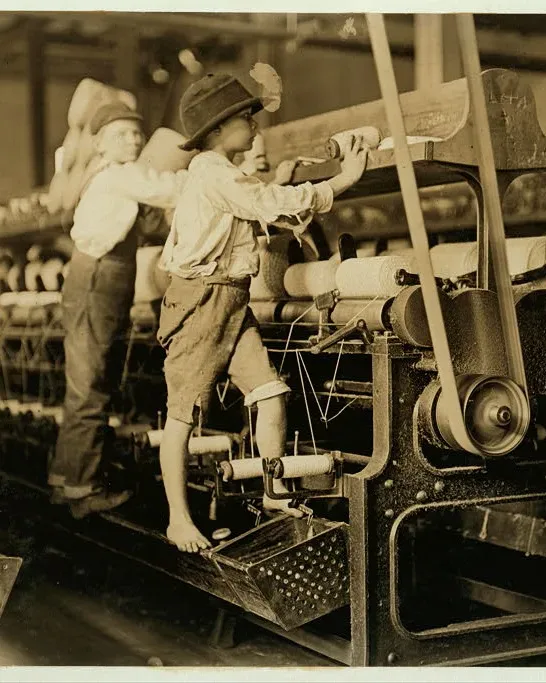
A spinner's job was to watch the frames and mend broken threads as the spindles turned. Hine's caption says the girl was tending her sides, the stretches of frame assigned to her, like a veteran.
She just happened in
What makes this photograph famous is the caption as much as the image. Hine wrote that after he took the photo the overseer came up and said, in an apologetic tone Hine called pathetic, that she just happened in, and a moment later repeated it. Hine added that the mills appeared to be full of youngsters who had just happened in or were helping sister. The phrase captures a familiar defense of the time: that small children found in a mill were not employees but visitors or helpers for an older sibling, and so did not count.
The caption ends with the words Witness Sara R. Hine. Sara was Hine's wife, and several of his captions from these early trips name her as a witness, giving the Committee a second person to vouch for what the photograph showed. Hine did not record the girl's name.
Why it became famous
The National Child Labor Committee distributed Hine's photographs in its reports and publications, placed them in newspapers and magazines, and showed them in lantern-slide lectures and exhibits. This picture works especially well in that role because its composition carries the message at a glance: one child, very small, set against the length of the machines she is expected to tend. Together with the overseer's excuse in the caption, it shows both the fact of child labor and the way it was explained away, which is why it is so often paired with its caption when it is reproduced.
What to look for
Notice how the picture is built. The two frames run from the edges of the photograph toward a vanishing point behind the girl's head, so every line of spindles leads the eye to her. She fills only a small part of the picture, yet nothing competes with her for attention. Look too at the floor, where loose cotton lies in the aisle she works, and at the light from the windows at the far end. Then read the caption again. The Library of Congress notes that Hine's captions often record quotations from the people he met, comments on how the photograph was taken, and the caption writer's own judgments and irony. All of these are present here, in the overseer's repeated words and in Hine's verdict that his tone was pathetic.
The print in this archive
This archive holds the Library of Congress record for Hine number 358, from the album titled Mills. The Library holds both the photographic print and Hine's original 5 x 7 inch glass negative, scanned as LC-DIG-nclc-01451 (print) and LC-DIG-nclc-05382 (negative). The archive also holds other photographs from the same December 3, 1908 visit, including one captioned Little spinner in Mollahan Cotton Mills, a wider view of a small girl standing in a similar aisle, and pictures of young doffers and sweepers in the same mill. Comparing them shows how Hine moved through the spinning room, varying his distance from the children he found.
Frequently asked questions
Who is the little spinner in the Mollahan Mills?
Hine did not record her name. His caption describes her only as a little spinner who was tending her sides like a veteran.
What does she just happened in mean?
It is what the mill overseer told Hine after he took the photograph, implying the girl was not really employed there. Hine noted that the mills seemed full of children who had just happened in or were helping sister.
Who was Sara R. Hine?
Sara Hine was Lewis Hine's wife. Several of his early National Child Labor Committee captions name her as a witness to the scene photographed.
When and where was the photo taken?
On December 3, 1908, in the Mollahan (also spelled Mollohon) Mills in Newberry, South Carolina.