Breaker Boys, Pittston, Pennsylvania (1911)
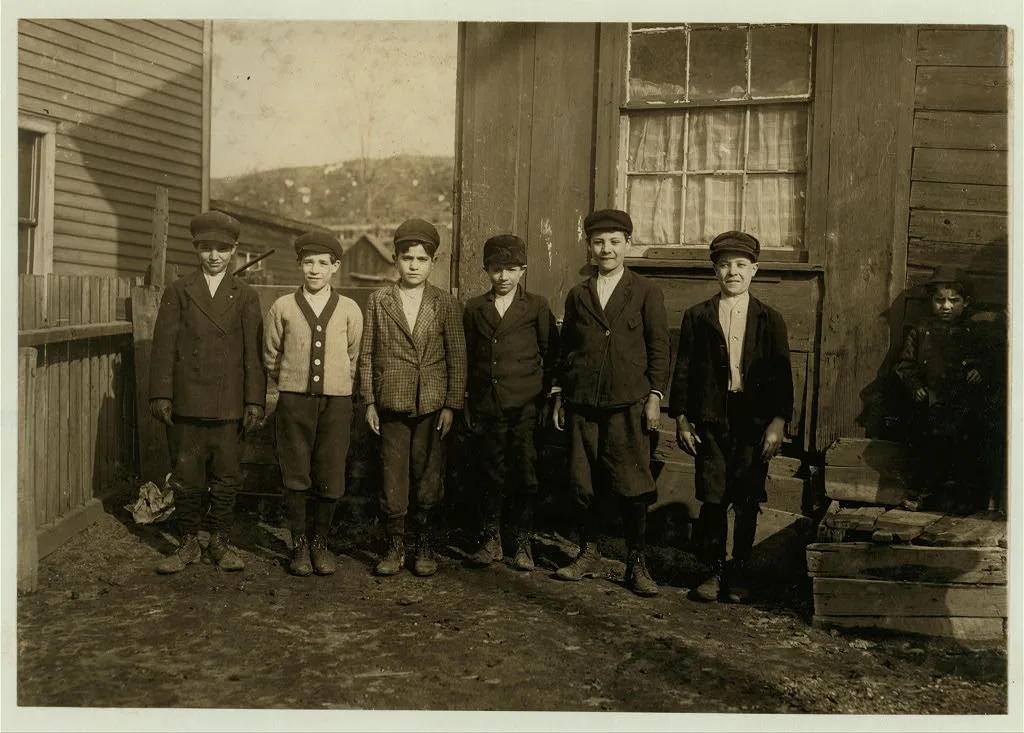
In January 1911 Lewis Hine photographed boys who worked as breaker boys at the Ewen Breaker of the Pennsylvania Coal Company near Pittston, Pennsylvania. This group portrait, made on a street outside the breaker, names each boy and records Hine's doubts about the ages they gave him. It belongs to the same visit as his famous pictures of boys bent over the coal chutes inside the breaker, and his caption cards link the two.
- Date
- January 1911
- Place
- Pittston, Pennsylvania (Ewen Breaker of the Pennsylvania Coal Company, South Pittston)
- Photographer
- Lewis W. Hine for the National Child Labor Committee (attribution based on provenance)
- Hine number
- 1928 (a second exposure of the same group is Hine no. 1927)
- Collection
- Library of Congress, National Child Labor Committee collection, LOT 7477, no. 1928; reproduction no. LC-DIG-nclc-01117
- Also known as
- Lewis Hine breaker boys; Breaker boys at Ewen Breaker; These are all breaker-boys (1911)
Who the breaker boys were
Anthracite coal came out of the Pennsylvania mines mixed with slate and rock. Before it could be sold it went through a breaker, a tall building where the coal was crushed, sorted by size and cleaned. Much of the cleaning was done by hand. Boys sat on wooden seats above chutes and conveyors and picked out the slate as the coal streamed past beneath them, typically for ten hours a day, six days a week. They worked without gloves, so cut and bleeding fingers were routine, and the dust in the air was heavy enough that later writers link it to asthma and black lung.
Pennsylvania had banned the employment of children under twelve in coal breakers in 1885, but the law was poorly enforced. Age papers could be forged by employers or by families who needed the wages. Contemporary estimates put the number of breaker boys in the state in the tens of thousands at the start of the twentieth century. Mechanical separators gradually took over the work, and stricter child labor and school attendance laws reduced the practice until it had largely disappeared by around 1920.
Hine in the coal fields, January 1911
Hine went to the anthracite region in January 1911 as an investigator and photographer for the National Child Labor Committee. In Pittston and South Pittston he photographed boys who worked at the Ewen Breaker of the Pennsylvania Coal Company, first outside on the street and then at work inside the breaker. The Committee numbered his prints in sequence, and the cards for the two outdoor group portraits (Hine numbers 1927 and 1928) carry the boys' names and addresses. The cards for the indoor views, numbered in the 1930s, send the reader back to them with the note that the names of some of the boys can be found on labels 1927 to 1930. The portrait in this archive is therefore the key that identifies some of the faces in Hine's better-known pictures from inside the breaker.
What the photograph shows
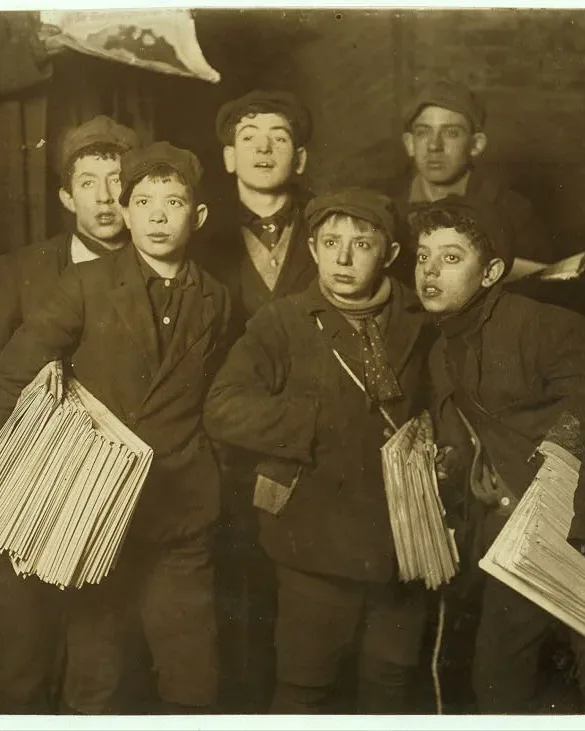
Six boys stand in a row against a weathered wooden house on an unpaved street, in caps, jackets and heavy boots, and another child sits on a step at the far right. A hillside rises behind them. Nobody is working; the picture is a portrait, and the boys face the camera squarely.
Hine's caption is unusually long and makes clear what kind of encounter this was. He wrote that the boys were very suspicious of his motives. He then went down the line: Sam Bellom, who said he had worked in breaker number 9 for two years and claimed to be 14, which Hine doubted; Sam Topent, two years at the Ewen Breaker, who insisted he was fourteen and could show proofs, though he had recently told his school principal he was 13; James Ritz, one year at the breaker, whose claim to be 14 Hine called unbelievable; Mikey Captan, who said he was 12 but did not look it; Tony Captan, from the same address; and Jo Topent, who also claimed to be 14 and refused to be in the first photograph. The caption records a Pine Street address for each boy. The pattern Hine was documenting is plain: boys who looked younger than the legal age reciting the age that let them work.
Why the breaker boy pictures became famous
Hine's images from inside the Ewen Breaker, in which rows of boys bend over the coal chutes in a haze of dust, became some of the most reproduced pictures of American child labor. One caption from that series reads, in part, that the dust was so dense at times as to obscure the view and that it penetrated the utmost recesses of the boys' lungs. The National Archives holds a print of one such view, dated January 10, 1911, in the records of the federal Children's Bureau, and the photographs are still used in classrooms to teach the Progressive Era.
The outdoor portrait is less often reproduced, but it is the half of the story that the indoor pictures cannot tell. Inside the breaker the boys are anonymous, bent figures. Outside, they have names, addresses, ages and voices, and Hine's caption records the gap between what they said and what he believed. That pairing of image and testimony is what made his work useful as evidence.
The print in this archive
This archive holds the Library of Congress print catalogued as Hine number 1928, from the album titled Coal mines in the National Child Labor Committee collection. The Library also holds a second exposure of the same group with the same caption, numbered 1927, which is not part of this archive. The famous interior views of boys at work in the Ewen Breaker are likewise not held here. The Library dates the photograph only to January 1911 and records the attribution to Hine as based on provenance, since the card itself does not name him. When looking at the picture, compare the boys' heights with the ages they claimed, which is exactly the comparison Hine wanted his readers to make.
Frequently asked questions
What did breaker boys do?
Breaker boys sorted anthracite coal by hand in the breaker, the building where coal was crushed and graded. Sitting above chutes and conveyors, they picked slate and rock out of the moving coal, usually ten hours a day, six days a week, without gloves and in heavy dust.
When and where did Lewis Hine photograph breaker boys?
In January 1911, at the Ewen Breaker of the Pennsylvania Coal Company in South Pittston and in nearby Pittston, Pennsylvania. He photographed the boys both on the street outside and at work inside the breaker.
Who are the boys in this photograph?
Hine's caption names Sam Bellom, Sam Topent, James Ritz, Mikey Captan, Tony Captan and Jo Topent, all living on Pine Street. Most told him they were 12 or 14, and he noted that he did not believe several of them.
Was it legal for children to work in Pennsylvania coal breakers?
Pennsylvania prohibited employing children under twelve in coal breakers from 1885, but enforcement was weak and age papers were often forged, so younger boys continued to work.
Does this archive have the famous photo of breaker boys inside the breaker?
No. This archive holds Hine's outdoor group portrait of breaker boys from the same visit (Hine number 1928). The interior views of boys at the coal chutes are in the Library of Congress but are not part of this archive.
Sources
- These are all breaker-boys... Pittston, Pennsylvania (Library of Congress catalog record)
- Breaker boys working in Ewen Breaker of Pennsylvania Coal Co. (Library of Congress catalog record)
- View of the Ewen Breaker of the Pa. Coal Co. S. Pittston, Pa. (National Archives, DocsTeach)
- Breaker boy (Wikipedia)
- A photograph of breaker boys at Pittston, Pennsylvania, January 1911 (Wynning History)
- National Child Labor Committee Collection: About this Collection (Library of Congress)