A Midnight Scene in the Glass Works, Bridgeton, New Jersey (1909)
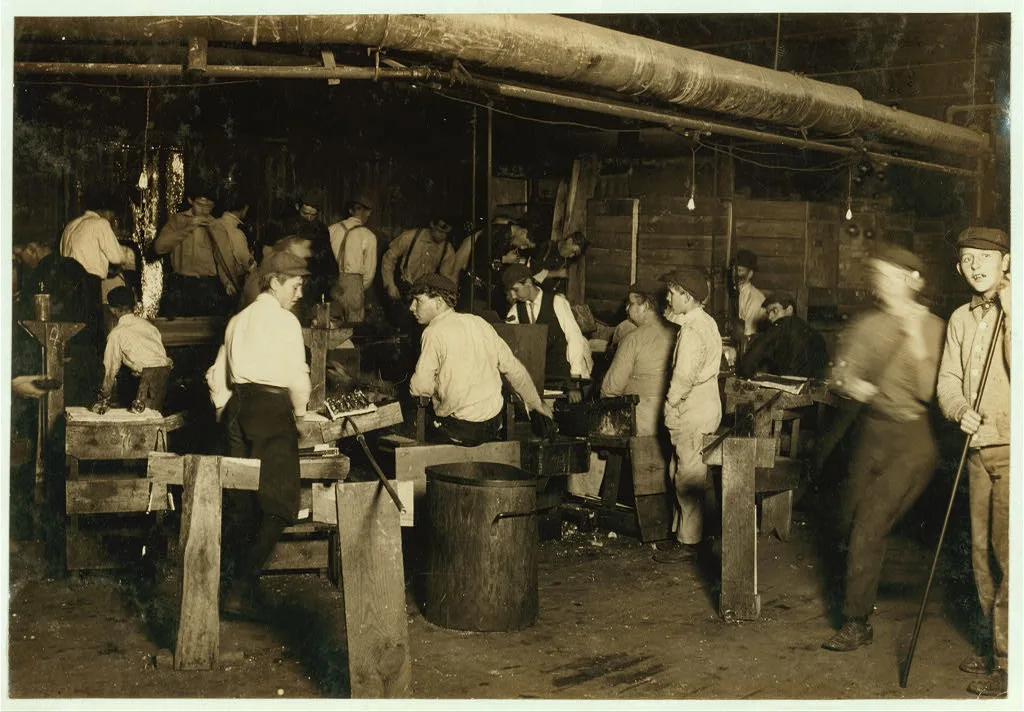
In November 1909 Lewis Hine photographed the night shift in two glass factories in Bridgeton, New Jersey, where boys worked alongside the glassblowers. This page covers that series, led by his midnight scene in the More-Jones glass works, in which a small snapper-up boy stands among the men at the benches.
- Date
- November 1909
- Place
- Bridgeton, New Jersey (More-Jones Glass Co. and Cumberland Glass Works)
- Photographer
- Lewis W. Hine for the National Child Labor Committee (attribution based on provenance)
- Lead image
- Hine no. 982, A midnight scene in More-Jonas [i.e., Jones?] Glass Works
- Collection
- Library of Congress, National Child Labor Committee collection, album Glass factories, LOT 7478
- Also known as
- Lewis Hine glass works; Midnight scene in More-Jones Glass Works; Glass factory boys night shift
Boys in the glass houses
Among manufacturing industries, the reformer John Spargo ranked glass second only to textiles in the number of children employed. Writing in 1906, he cited census figures showing that in 1900 more than 7,000 of the roughly 53,000 workers in American glass manufacture were children under sixteen, and he believed the true number was higher. The industry was concentrated in Pennsylvania, Indiana, Ohio and New Jersey, and boys worked on the night shifts as well as by day.
Spargo described the boys' jobs in a bottle factory. Take-out boys lifted half-formed bottles from the molds. Snapper-ups picked up the bodies of the bottles with tongs and heated their necks for the finishers. Carrying-in boys ran the red-hot bottles on asbestos shovels to the annealing oven, where they cooled slowly; he called this by far the hardest work. Spargo's friend Owen R. Lovejoy of the National Child Labor Committee measured the carrying-in boys' route in one typical factory: a hundred feet to the oven, seventy-two trips an hour, nearly twenty-two miles in an eight-hour shift. Spargo put their pay at sixty cents to a dollar for eight hours, and he warned that the glare of the furnaces damaged the boys' eyesight and that burns were common. He also noted that New Jersey had forbidden the employment of boys under fourteen since 1903 but placed no limit on night work for boys of that age, and he quoted a glassblower in Glassboro, New Jersey, who said he would sooner see his son dead than working in a glass factory.
Hine in Bridgeton, November 1909
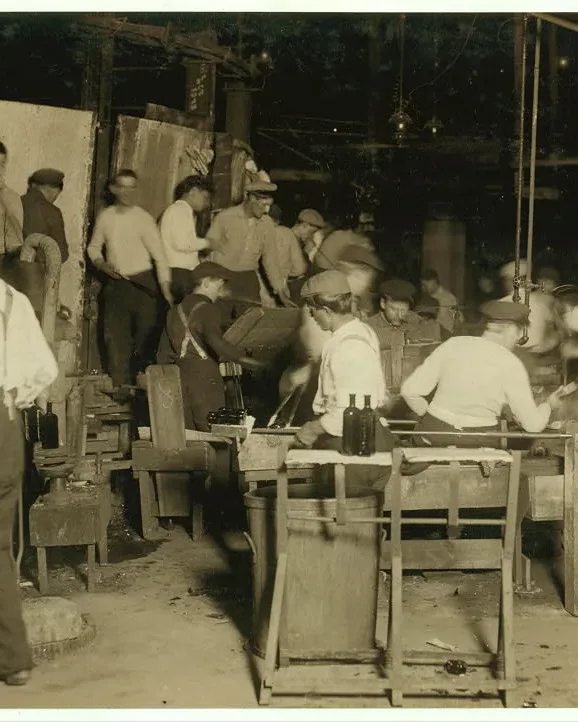
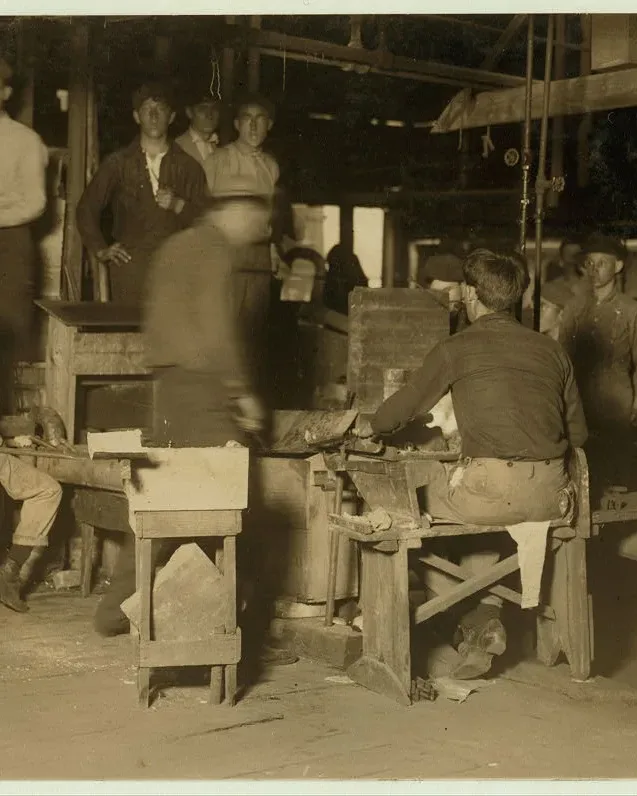
Hine went to Bridgeton, in southern New Jersey, in November 1909. His captions name two factories, the Cumberland Glass Works and a plant recorded as More-Jonas, which a later cataloguer queried as More-Jones; another card reads More-Jones Glass Co. He photographed the night shift going to work, workers waiting outside, the lunch break on the night shift, and scenes on the factory floor. Several captions point the viewer to the children: four small boys are to be seen in this photo; three of these boys may be under 14; a young holding-mold boy on the left and a young carrying-in boy in the middle distance. One names a small boy, Harry Simpkins, and his street address, and comments on the dirty, noisome conditions.
What the midnight scene shows
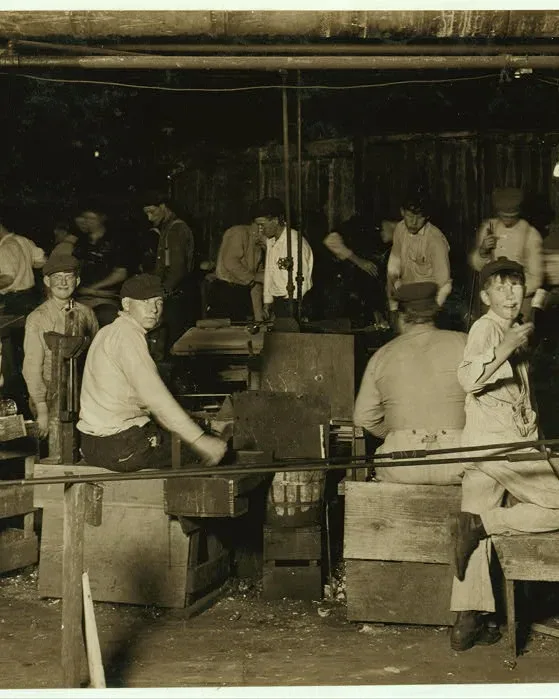
The lead photograph looks across a crowded, low-ceilinged factory floor lit by bare bulbs, with a heavy insulated pipe running overhead. Men and boys work at wooden benches and stands; a large metal barrel stands in the foreground. Several figures are blurred, moving during the exposure. At the left, as the caption directs, is a small snapper-up boy among the men. At the right a boy holds a long iron rod, and a figure in motion carries another. The companion photograph, Hine number 983, shows the same room from a similar angle, and its caption counts four small boys in the frame. The bracketed query in the factory's name is the Library of Congress's own: its catalogers transcribed the caption cards as written and flag likely errors, and the Library cautions that the cards are not always easy to read and may contain misspellings.
Why the glass works pictures matter
Night work by children was one of the issues the National Child Labor Committee pressed hardest, and the glass industry was its clearest example. Hine's pictures show what written reports could only describe: boys among adult men in the middle of the night, in heat, glare and motion, with no sense that they were out of place. Hine photographed glass factories in several states, and the Bridgeton pictures are among the most detailed in their captions. The motion blur and harsh light also show how difficult these conditions were for Hine himself to photograph.
The photographs in this archive
This page treats the Bridgeton pictures as a series. The lead image is the Library of Congress print catalogued as Hine number 982. The archive also holds number 983, the second midnight scene in the same factory; number 971, a night scene at the Cumberland Glass Works with a small boy in the middle distance; number 959, the Cumberland scene identifying a holding-mold boy and a carrying-in boy; and two further night scenes at Cumberland. The archive also holds Hine's glass-house pictures from other South Jersey towns, including Millville, Clayton and Cape May.
Other versions in the archive
A midnight scene in More-Jonas [i.e., Jones?] Glass Works,…
1909
Night scene in Cumberland Glass Works, Bridgeton, N.J.…
1909
Scene in Cumberland Glass Works, Bridgeton, N.J. A young…
1909
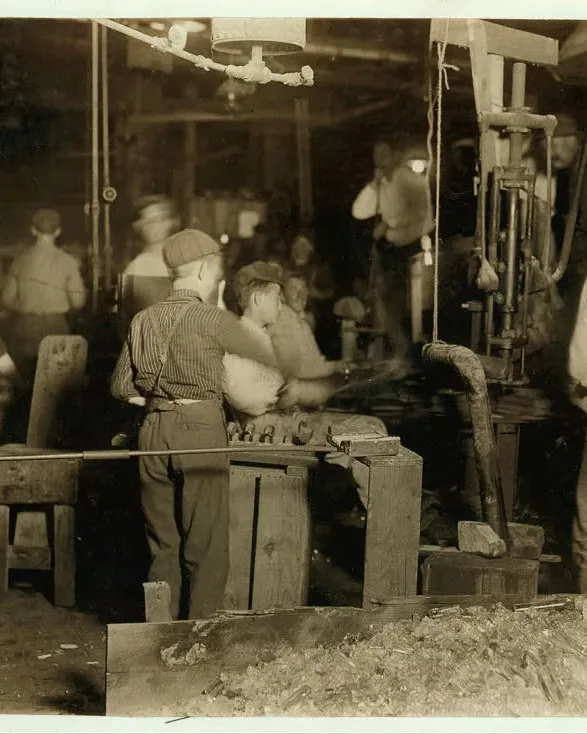
Night scene. Cumberland Glass Works, Bridgeton, N.J.…
1909
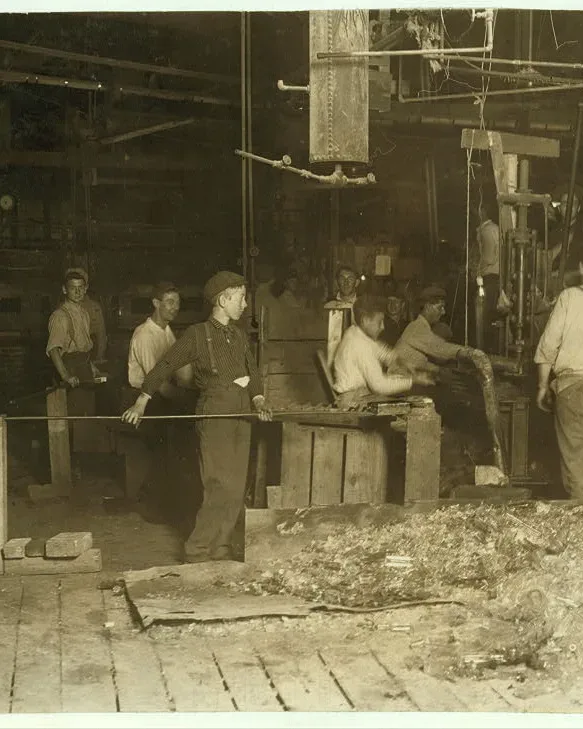
Night scene. Cumberland Glass Works, Bridgeton, N.J.…
1909
Frequently asked questions
What was a snapper-up boy?
In a bottle factory, a snapper-up took the half-made bottle from the mold with tongs and heated its neck so a finisher could shape it. John Spargo described the job in his 1906 book The Bitter Cry of the Children.
What did carrying-in boys do?
They carried freshly made, red-hot glassware from the benches to the annealing oven, where it cooled slowly. Spargo described them as kept on a slow run all the time and called it by far the hardest of the boys' jobs.
When did Lewis Hine photograph the Bridgeton glass works?
In November 1909, at the Cumberland Glass Works and a factory recorded as More-Jones (More-Jonas on one card) in Bridgeton, New Jersey.
Did children work night shifts in glass factories?
Yes. Boys worked night shifts in glass factories, and Hine photographed them at midnight in Bridgeton. Spargo reported that New Jersey banned employing boys under fourteen from 1903 but did not restrict night work for boys of that age.
Sources
- A midnight scene in More-Jonas [i.e., Jones?] Glass Works, Bridgeton, N.J. (Library of Congress catalog record)
- A midnight scene in More-Jonas Glass Works... Four small boys (Library of Congress catalog record)
- John Spargo, The Bitter Cry of the Children (Project Gutenberg)
- Glass Curiosities: Lewis Hine's Child Labor Photos (UrbanGlass)
- National Child Labor Committee Collection: About this Collection (Library of Congress)